
 Search
Alex Turner didn’t live high enough to feel above the city, but he lived high enough to watch it.
Fourth floor. East London. A view that looked better in photos than it did through a slightly dirty window. The buildings caught the late afternoon light, glass and steel reflecting gold in patches, but Alex wasn’t admiring the skyline. He was watching movement below: the traffic stutter at the junction, pedestrians drifting past shopfronts, a cyclist cutting too close to a bus.
He’d been trained to look for patterns. He’d also been trained to look for the absence of patterns, which was harder. Anyone could spot a man sprinting down the pavement. It took time to learn how to spot someone pretending not to follow you.
He told himself it was a habit now. Something left over. A reflex.
He didn’t fully believe it.
The flat behind him was quiet. Almost clinically so. Sparse furniture, chosen because it didn’t make him feel anything. A sofa that was comfortable enough but not inviting. A table that was more workspace than dining space. A chair angled so the door was visible without being stared at. There was very little that said home, and that was by design. Homes made you soft. They made you keep things. They made you hesitate.
The one indulgence sat on a side table near the window: a chessboard, pieces arranged mid-game.
White to move. He’d left it there three days ago and every time he passed it, his eyes caught on the position. There were at least two decent options and one risky one. Any of them could work if played well.
He hadn’t touched it.
His phone vibrated.
Encrypted messaging app. Unknown contact. No caller ID, no number. Just a line of text on a blank screen.
Opportunity of a lifetime. Interested?
Alex read it once. Then again, slower. He waited for the follow-up. Nothing came.
He typed one word.
Details.
Then he stood still, phone in his hand, eyes on the street like the answer might appear in the reflection of a passing car.
He waited.
Three minutes passed. Four.
His eyes flicked to the bookshelf. It looked ordinary. It wasn’t. He ran his fingers along the spines until he found the slight shift in texture, pressed, and the shelf gave a soft click. A narrow compartment opened behind it. Inside sat a secure laptop, military encryption, biometric lock.
He stared at it, then slid the shelf closed.
His phone vibrated again.
Just an address and a time. Covent Garden. Two hours.
Public. Busy. Cameras everywhere. A meeting place chosen by someone who understood that the easiest way to stay invisible was to stand in the open.
He moved, stepping away from the window. He laid out what he needed on the table. Wallet. Keys. Burner phone. A second set of keys that never left the flat unless he had to leave quickly.
He opened the wardrobe and chose the less impressive of his two dark suits. In London, you could stand out by looking rich. You could also stand out by looking poor. The trick was to look like someone nobody needed to remember.
The last job had been months ago. He’d stepped back because he’d started to feel something creeping in: complacency. A sense of routine. That was dangerous.
Still, he’d missed it. The edge. The hum in the bloodstream when things were moving.
Military intelligence. Years spent reading reports and faces, learning to interpret silences. He’d believed in the work at first. Then the story frayed. Bureaucracy. Politics. Missions justified by words like necessary and unavoidable.
He’d walked away before the job finished hollowing him out.
He checked his watch. One hour forty-six minutes.
He left the flat, locking the door, then checking it twice because the brain was a stubborn machine. The corridor smelled of someone else’s cooking. Onions and something greasy. He walked down the stairs rather than taking the lift. Again, irrational. Again, habit.
Outside, London hit him with noise and movement. The air had a damp chill in it, the sort that got into your clothes without asking permission. He didn’t bother with a coat. The suit jacket was enough.
He took the route to Covent Garden that he’d decided on in his head, then changed it after two streets because the day felt wrong. There was no logical reason for that. He disliked that too.
He doubled back once, letting a group of school kids pass him, loud and careless. He checked the reflection in a bus window and saw only what he expected to see: faces, commuters, a man in a suit looking at his phone like everyone else.
Still, he kept scanning. In this line of work you didn’t need to be paranoid. You needed to be accurate. The trouble was, accuracy often looked like paranoia to people who’d never had anything worth being followed for.
The café was exactly as advertised by its own lack of identity. Not a chain, not a hole-in-the-wall. Windows fogged with steam. A faint smell of burnt espresso and sugar. Background music low enough to be ignored.
Alex stepped inside and did the sweep without looking like he was doing the sweep. Two exits. One toilet corridor. The counter. A barista who looked bored. Students on laptops. A couple sharing a pastry and pretending not to be in love with each other. Tourists with maps. A man in his sixties reading a newspaper like it still mattered.
He ordered an espresso and chose a corner table with his back to the wall. He didn’t like sitting with his back to a room. Some instincts were too ingrained to argue with.
He waited. Waiting was harder than moving. Waiting invited thought.
At precisely the time given, the man walked in.
Unremarkable. A suit like Alex’s. Average height. Hair cut in a way that suggested the same trim every three weeks. A face that would slide off your memory unless you made an effort to hold on to it.
But the movement was wrong for an ordinary man. Too economical. Too aware.
His eyes swept across the café and paused, just briefly, on Alex’s corner table.
He approached without hurry and sat down.
Alex didn’t offer his hand. Neither did the man.
‘I understand you have a proposition,’ Alex said quietly.
The man smiled, but it didn’t reach his eyes. ‘Indeed, Mr Turner.’
Alex felt a small flare of irritation. He hadn’t given his name.
‘How would you like to make history?’ the man asked.
Alex let the silence stretch.
The man waited. That was a good sign. Or a worrying one.
‘I’m listening,’ Alex said.
‘What I’m about to propose is the most ambitious operation attempted on British soil.’ The man lowered his voice. ‘The target is a vault in central London. State-of-the-art. Built with the assumption that nobody will ever get in without permission.’
Alex took a sip of espresso. It was bitter, slightly burnt.
‘The security is unprecedented. The risks are enormous. But the reward would set you up for life.’
Alex set the cup down with care. ‘Who are you?’
The man’s smile twitched. ‘Names are unhelpful.’
‘That depends,’ Alex said. ‘On whether you expect me to trust you.’
The man leaned back slightly. ‘Trust is a big word. I’m offering information and an opportunity. You can decide what to do with it.’
Alex watched him. ‘Why me?’
‘Because you’re competent. Because you’re cautious. Because you don’t talk. And because you don’t have the weaknesses most men have.’
Alex felt a flicker of annoyance. ‘That last part isn’t true.’
The man’s eyes held his. ‘You’ll find the details useful.’
Alex waited a beat. ‘You’re the Broker.’
The man didn’t confirm it. He didn’t deny it either.
‘Details,’ Alex said again. ‘Real ones.’
The Broker reached into his jacket slowly and produced a small, unmarked USB drive. He placed it on the table between them.
‘Everything you need is on there. The target. The security profile. The constraints. The timeline. The reason it’s possible at all.’
Alex didn’t pick it up. Not yet.
‘If it’s possible, why isn’t whoever hired you doing it themselves?’
The Broker’s smile returned. Thin. ‘Because they don’t want to be seen doing it. They want distance. And because the people who want this done are used to buying solutions.’
‘How long do I have?’ Alex asked.
‘Forty-eight hours. There’s an encrypted channel on the drive. If you’re in, you’ll know what to do.’
‘And if I’m not,’ Alex added, ‘do the people behind this let me walk away?’
The Broker’s eyes didn’t change, but something in the air did. A subtle tightening.
‘You’re a sensible man. You’ll make a sensible decision.’
It was the closest thing to a threat Alex had heard so far, and it was delivered politely, which made it worse.
The Broker stood. Smoothed his jacket.
‘One more thing,’ Alex said.
The Broker paused.
Alex tapped the USB drive lightly with a finger. ‘Why now?’
The Broker considered him for a moment. ‘Because the window is open. And it won’t stay open.’
Then he walked out.
Alex watched him go, tracking the movement through the café, the way he threaded past tables without touching anyone.
When the door shut behind him, the café noise filled the gap.
Alex picked up the USB drive. It was light. Almost nothing. And yet it seemed to pull at his attention as if it had weight of its own.
He pocketed it, finished his espresso, and left a tip. In places like this, you wanted to be remembered as a decent man. Not a memorable man.
Outside, the air felt colder. The sky had the look of rain that hadn’t decided whether to commit.
Alex walked without heading straight for home. He didn’t want to go there immediately. Not if there was even a small chance he’d been made. Not if the Broker’s people were thorough.
He took a looping route, moving with the city, letting crowds swallow him, checking reflections as he passed shop windows. He made himself stop in a bookshop and pretend to browse. He let a minute pass, then two, then walked out again. Nobody followed. Nobody looked twice.
He told himself that meant he was safe. He didn’t fully believe it.
On the Tube platform, he checked the time again. He’d been doing that a lot. It annoyed him.
The train arrived with a howl, doors opening, commuters spilling out in a tired wave. Alex stepped in, found a spot near the door, and watched faces without staring. An exhausted woman in scrubs. A teenager with headphones too loud. A man reading emails with a tight jaw as if the emails had offended him personally.
Normal people. Normal lives.
Alex wondered, briefly, what it would feel like to be one of them. The thought didn’t last. It was too alien.
Back in his flat, he locked the door and stood still, listening. The building creaked. Pipes sighed. Someone upstairs dropped something with a dull thud.
He set the USB drive on the table and stared at it.
Part of him wanted to plug it in immediately. Another part of him wanted to smash it with a hammer and pretend it had never existed.
He didn’t do either. He paced, once, then stopped, annoyed at himself.
He opened the hidden compartment behind the bookshelf and pulled out the secure laptop. This was what it was for. This, and only this. He set it up on the table, powered it on, and waited as the encryption layer booted.
He scanned the drive first, isolated, air-gapped. He’d learned those lessons the hard way. The drive could contain more than information. It could contain a door.
The scan took longer than he wanted. He watched the progress bar as if he could make it move faster by staring.
The scan came back clean. Clean things were rarely clean, but it was a start.
He opened the files.
And then, despite all his effort at control, he felt his stomach tighten.
Because the Broker hadn’t been overselling it. A vault that wasn’t just secure but obsessively secure. Layers of authentication. Redundant systems. Human oversight built into the technology. A place designed to remove luck from the equation.
It was, in other words, a challenge.
Alex leaned back, rubbed a hand over his face, and found himself laughing once, quietly, without humour.
He hadn’t wanted a job. Not really. He’d wanted the quiet.
Now the universe had offered him the opposite.
He read further. Timeline. Constraints. A window that would close. A reason the job had to happen now, not later.
When he finally stopped, the room felt smaller.
He checked his watch. He’d lost nearly forty minutes without noticing.
He was going to need help. Not generic help. Not ‘a team’ in the way people fantasised about teams. He needed specific skills. And he needed people he could tolerate under pressure, which narrowed the list more than any job requirement ever could.
His mind landed on Lisa Bennett almost immediately. The best hacker he’d ever worked with. That was an objective fact, not flattery. She saw systems the way some people saw music. Patterns, rhythms, weak notes. She also had the attention span of a cat in a room full of laser pointers. Brilliant, difficult, unpredictable.
He didn’t like unpredictability. He liked results.
He picked up his burner phone and scrolled to a number he hadn’t used in months.
He called.
It rang twice. Three times.
Then a voice, bright and sharp. ‘If this is about crypto, I’m not interested.’
‘Lisa,’ Alex said.
A pause. Then, ‘Alex?’
‘It’s been a while.’
‘You’re either calling because you miss me, which would be weird, or because you’ve found something nasty.’
Alex almost smiled. ‘Define nasty.’
‘Send it.’
‘I haven’t decided yet.’
‘Actually, you’re calling because you have already decided. You just want someone else to confirm it so you can pretend you’re cautious.’
Alex didn’t answer, which was answer enough.
‘Where are you?’ she asked.
‘In London.’
‘I assumed. You always sound like London. Send me the basics. Use the old channel.’
‘Not this time. This is more of a face-to-face deal,’ Alex said.
‘Ooh, intriguing. Just message me a time and a place. And Alex?’
‘Yes.’
‘Try not to get yourself killed. It’s a pain having to find new clients.’
She hung up.
Alex stared at the phone for a second, then set it down. He felt slightly better. Lisa had that effect. She made the world feel like a set of puzzles again, not an oncoming wave.
He looked back at the files on the laptop.
Lisa was one piece. He needed muscle too. Not because he wanted violence, but because violence had a habit of arriving whether you invited it or not. Someone who could act without panicking. Someone who wouldn’t freeze when a plan broke.
Joe Mason came to mind. Former boxer. Ex-military. Big enough to intimidate without trying. Smart enough to listen. Joe wasn’t subtle, but he didn’t need to be. He was a wall you could move.
And for infiltration, someone who could walk through doors that were locked by assumption rather than keys. Maria Thompson. The Chameleon. Maria could become whoever she needed to be. She could make you believe you’d met her before, which was an unsettling talent to have in a woman you didn’t fully trust.
Alex didn’t trust anyone fully. That was the point.
On the table, the chessboard caught his eye.
White to move.
He stared at it for a long moment, then reached out and moved a piece. Not the safest move. Not the cleverest. The move that committed him.
He sat back. The piece looked wrong in its new position, and yet it also looked inevitable.
Alex turned back to the laptop and began making notes. Real notes, not a neat plan.
Questions. Concerns. Things he didn’t like.
Outside, London carried on, indifferent.
Inside, the quiet flat felt less like a refuge and more like the last calm breath before something sharp and fast and irreversible.
He didn’t know yet whether this job would set him up for life.
But he knew one thing with uncomfortable certainty: it was going to change it.
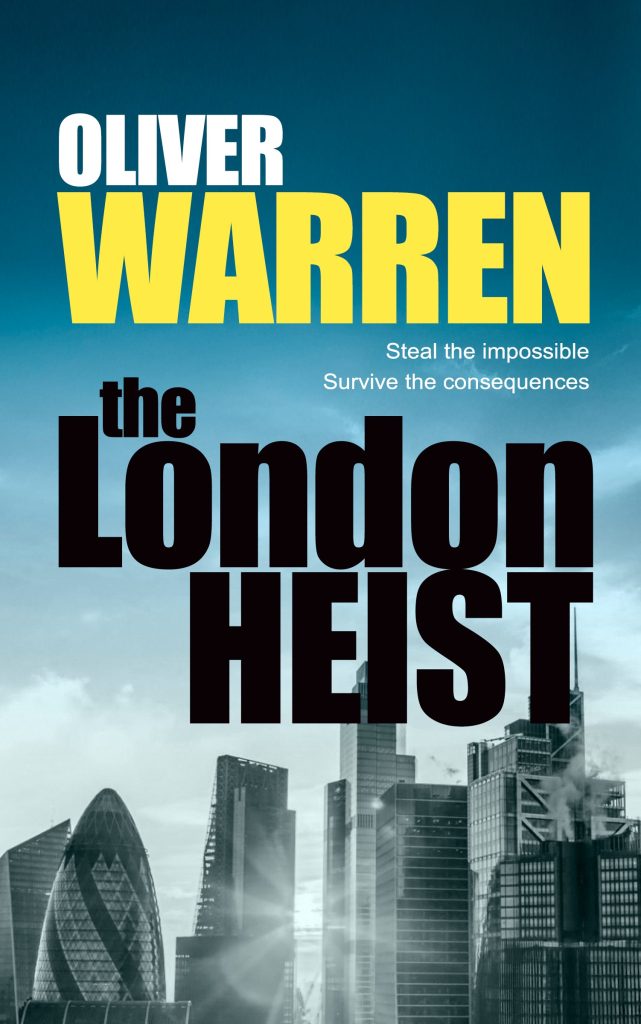
The London Heist – Oliver Warren
Plant a tree by ordering on our website, or available to order at all major retailers and your local indie book shop.